

ARTIFICIAL INTELLIGENCE VS. INTELLIGENCE AMPLIFICATION
In 1973, Scientific American published a chart comparing how much energy different animals used to move a unit of body weight over a unit of distance.
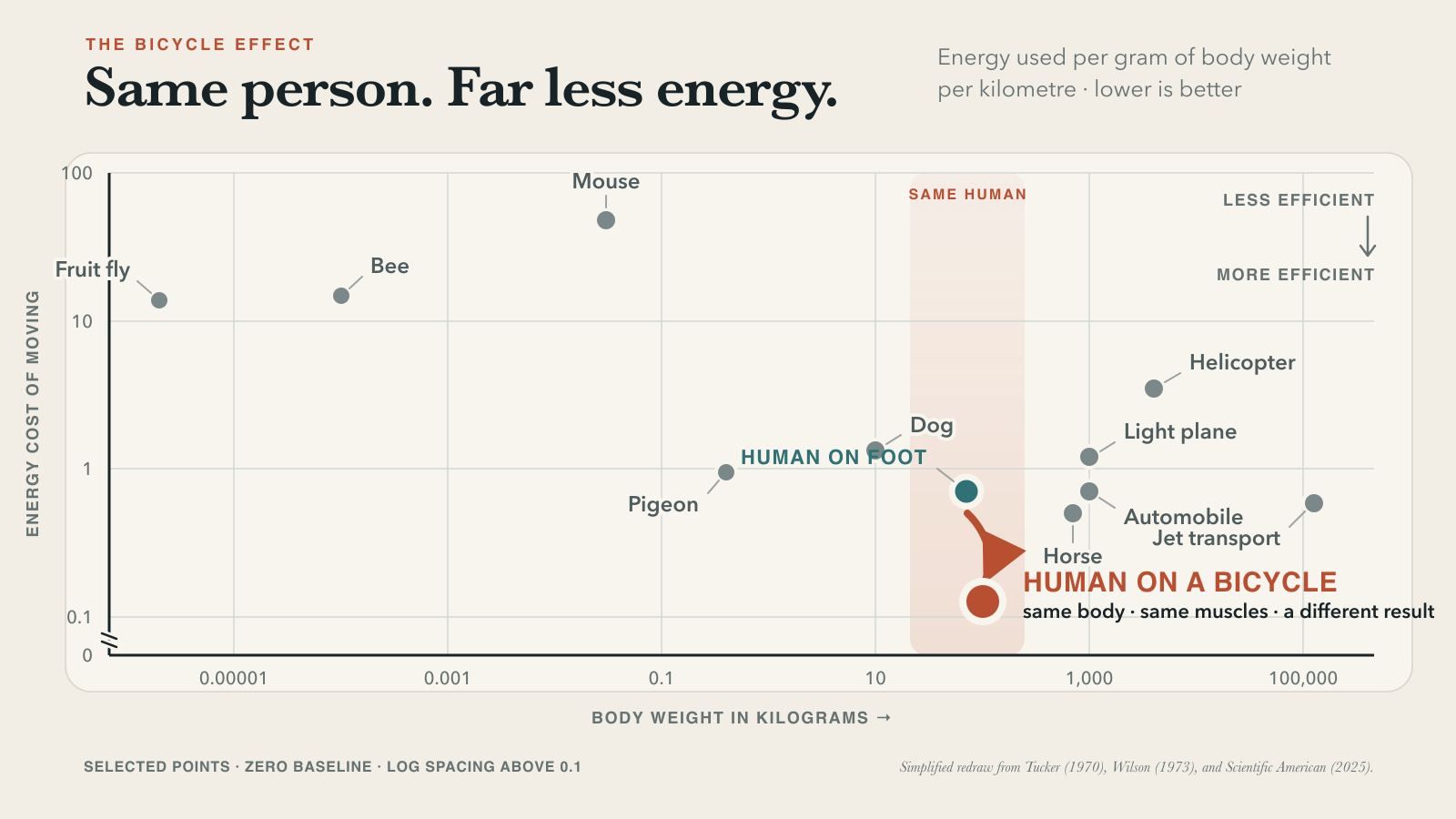
Humans on foot were unremarkable. But one point dropped far below almost everything else on the chart: a human on a bicycle.
The same body, with the same muscles, suddenly became one of the most efficient travellers on the chart. The person had not become stronger. A tool had multiplied—or amplified—what an ordinary body could do.
Steve Jobs later used this comparison to describe the personal computer: a bicycle for the mind.
It remains a useful metaphor in the era of AI. A capable model can multiply one person’s ability to write, analyse, design, or code. But that’s human intelligence amplification.
But the metaphor also reveals a limit.
A bicycle amplifies one rider. It does not provide a map, a shared destination, traffic signals, or a way for several travellers to coordinate.
Those belong to the road.
A smart part is not yet a smart whole. This article is about the infrastructure between them.
How alignment research led to ChatGPT
In 2020, OpenAI introduced GPT-3. During training on a vast collection of text, it adjusted 175 billion internal numbers called parameters.
GPT-3 was a remarkable engine. But people often had to craft prompts, add examples, or discover special wording to get useful results.
The problem was not only capability. It was alignment between the model’s behaviour and the user’s intention. Does the model actually answer the user’s question or request?
Researchers then trained models with examples of instructions and helpful responses. People compared several answers and selected the better ones. This produced InstructGPT.
In one comparison, people preferred answers from a 1.3-billion-parameter InstructGPT model to answers from the original 175-billion-parameter GPT-3.
The hundred-times smaller model did not suddenly know more about everything. It had become better aligned with the tasks people were actually giving it.
Later in 2022, ChatGPT placed that idea inside a conversational interface.
The visible breakthrough was conversation.
The underlying breakthrough was alignment.
The InstructGPT paper contains a wonderfully simple example. Two models of the same size receive a recipe for stuffed zucchini and one instruction: create a shopping list from this recipe.
GPT-3 keeps cooking: “Bake, uncovered, at 350° for 20-25 minutes or until zucchini is tender and cheese is melted.”
InstructGPT begins the same way—“Bake, uncovered, at 350° for 20-25 minutes.”—and then supplies the list: zucchini, ground beef, onion, mushrooms, pepper, cheese, ketchup, salt.
Neither answer is perfect. Only one produces a shopping list.
The lesson is simple:
Knowing how to do many things is not the same as doing the thing that was asked.
A tandem bicycle for thought
Douglas Engelbart is often remembered as a pioneer of human-computer interaction—especially for demonstrating the computer mouse. That can make his work sound like a search for easier ways for one person to control one computer.
But that was only part of the idea.
In his 1962 report Augmenting Human Intellect, Engelbart argued that human problems were becoming more complex faster than our ability to solve them. His answer was not a machine that thought alone. It was a combination of people, tools, language, methods, and training that could improve how humans worked together.
The 1968 demonstration made that larger idea visible. Engelbart sat on a stage in San Francisco. His colleague Bill Paxton was at their laboratory over 30 miles away in Menlo Park. They could see the same text, point to it with two different cursors, talk by live audio and video, and work out a problem together.
The computer did not replace either person. It gave both people a larger shared space for thought.
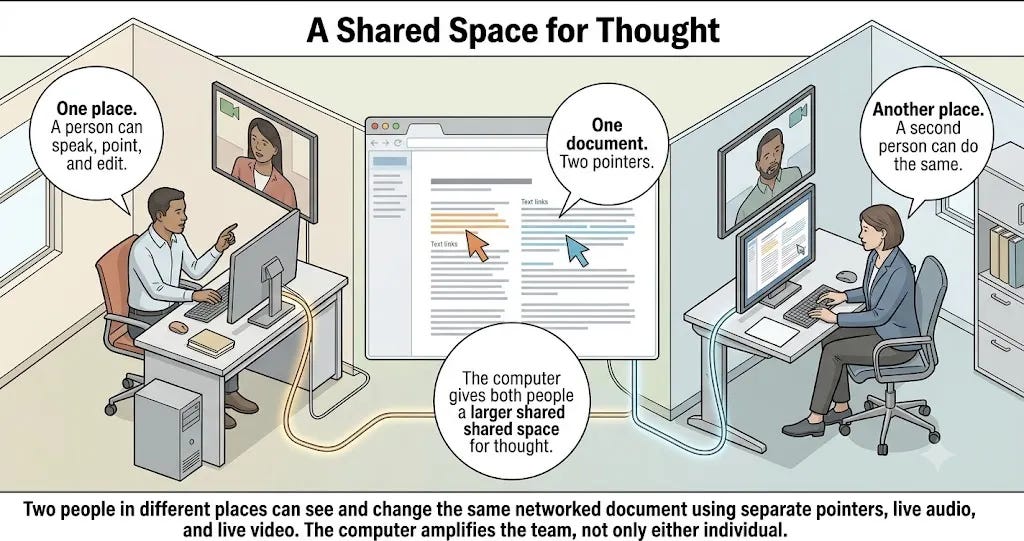
That is team intelligence amplification: not merely making one person faster, but helping several people see and shape the same problem. It is like two people going much faster with a tandem bicycle than with two separate bicycles. In the era of AI, this is called multiplayer AI.
For the tool to gain value, it needs to fit the way a team is trying to think. It needs to be aligned not only with each individual, but with the way the team works together.
An AI model can be measured in isolation. An intelligence-amplification system is measured by what the team can do.
Scales of amplification
A bicycle, a tandem, a street, a street grid, and a road network all help people move. But each works at a different scale:
A bicycle amplifies a person. It turns the same legs into greater speed and range.
A tandem amplifies a team. Two riders share one machine, and they can go faster and further than either could go alone with two bicycles.
A street amplifies a community. It gives homes, shops, workers, visitors, and deliveries a shared place to meet and exchange things.
A street grid amplifies a town. It connects many streets, so people can reach places and people beyond their immediate neighbourhood.
A road network amplifies a country. It connects towns across a larger territory, carrying people, food, materials, messages, and services between them.
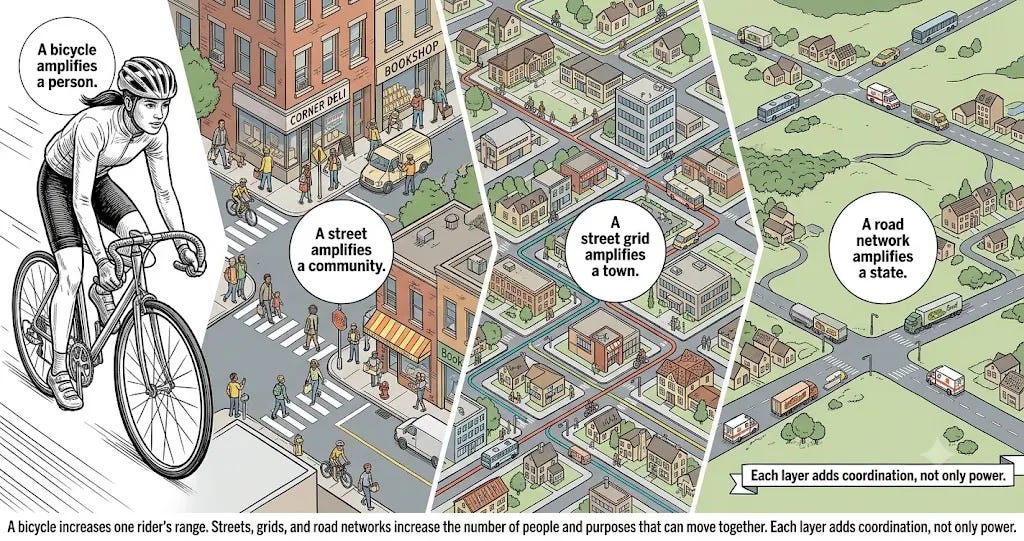
At every step, the scale of coordinated action grows. More power is part of the story, but coordination is the larger part.
Roads even limit individual movement in useful ways. Lanes constrain where vehicles go. Signals make them wait. Junctions decide who moves first.
Those small limits allow thousands of strangers to share the same network without planning every encounter in advance.
Infrastructure amplifies people by aligning their independent actions.
The same pattern appears in intelligence, rung for rung. A capable AI amplifies a person. A shared workspace amplifies a team. Institutions amplify a community. Networks of institutions amplify coordination across towns and countries—and, eventually, across a planet.
A smart planet would not be a single world-sized mind. It would be many minds, teams, and communities able to contribute without being flattened into one.
At each new scale, alignment becomes harder. The question is no longer only whether one part works. It is whether the parts can work together.
The street as an institution
Jane Jacobs described a successful street not as an empty channel for moving traffic, but as an institution.
A working street combines physical design with repeated interactions, visible activity, local knowledge, informal signals, and shared expectations. Shopkeepers, residents, delivery workers, children, and strangers use the same space for different purposes without receiving instructions from one central controller.
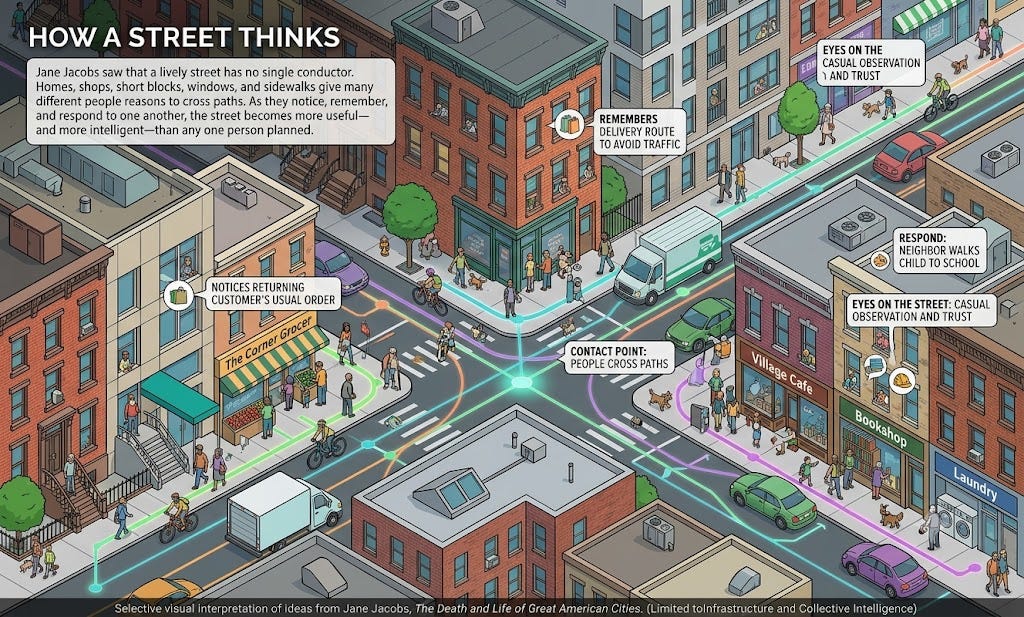
Jacobs called this organized complexity, borrowing a term from Warren Weaver: many different parts affect one another, but not at random. The apparent mess is not the absence of structure. It is structure produced by many small roles and adjustments operating at once.
The value of the street cannot be measured only by how quickly traffic passes through it. The street also carries information. People see what is open, who is present, where attention is needed, and how the place is being used.
It also supports collaboration. Deliveries meet shops. Customers find services. Neighbours exchange small pieces of knowledge. Repeated contact creates memory.
The street works as infrastructure because it combines movement, information, and coordination, allowing the community to act as more than a collection of individuals.
That is a richer model for AI infrastructure than raw computing power. Let’s explore how this could work.
Two tests from the Amish
Once a tool affects a whole community, alignment opens a new question: good for whom?
The Amish are often described as being opposed to, or afraid of, technology. That is too simple. Many Amish communities evaluate technologies selectively rather than treating newness as automatically good or bad. Their decisions vary, but two recurring criteria are useful here:
1. Does the technology strengthen the whole community, or mainly increase individual convenience?
2. Does it preserve independence, or create dependence on an outside system?
These are alignment questions. They evaluate the tool together with the larger system in which it will operate.
The telephone is a good example. A phone helps one person save a journey. But if every conversation becomes a call, the community may lose visits and time spent together. Some Amish groups therefore placed a shared telephone away from the home, keeping the useful function while limiting how much it changed daily life.
Electricity provides another example. Many Amish groups avoid a permanent connection to the public grid but still use batteries, diesel power, compressed air, or solar panels. The issue is not electricity itself. The question is whether the tool remains locally controlled or creates dependence on a network outside the community.
The point is not the particular answer any Amish community reaches. It is the size of the question: the tool, its users, their relationships, and their dependencies are considered together.
Many ways to matter
The Amish questions ask what a tool does to a community. There is a second community question underneath them: what is the community measuring its members against?
A balanced community needs leaders, carers, planners, jokers, fixers, and quiet observers. If everyone is pushed toward the same prize—the most money, attention, power, or points—the result is like a cave full of dragons fighting over one treasure.
Astrology offers a strange example of the opposite pattern. It hands people different types based on the day or the year they were born—a roll of cosmic dice rather than a competition for the most popular roles. The point is not that astrology would predict the type, it’s that it assigns the type, and then relies on self-fulfilling prophecy. As a result, societies relying on astrology might be doing better than ones ignoring it.
We can pursue alignment across people by encouraging and recognising different forms of contribution, so that a community can support a variety of roles.
One more minute. One more bite.
Scale asks whether a tool is good for one person or for the larger group. Time adds another question: good for how long?
Imagine a game that counts every extra minute of play as a success. The easiest way to raise the score may be to make the game difficult to put down.
Or imagine a snack company that counts every extra bite. The easiest way to raise that score may be to make the snack so tasty that people reach for another before deciding whether they are still hungry.
Minutes played and bites eaten are easy to count. Health, curiosity, friendship, rest, and freedom are harder.
That does not make fun or tasty food bad. The mistake is treating the next minute or the next bite as the whole purpose.
A system can be perfectly aligned with a short-term score and poorly aligned with a person’s longer life.
One name for that larger goal is human flourishing: people growing healthier, more capable, more curious, and more connected.
No single score captures all of that. But a system can remember that the quick reward is only one part of the picture. It can notice when today’s win borrows too much from tomorrow.
A thermometer is not warmth.
Optimise the thermometer and you get a warm thermometer in a cold room.
From power to infrastructure
The questions now line up. Can the tool do the job? Can a team use it to think together? What happens to everyone around it? Does today’s success still look good tomorrow?
Programmers already rely on infrastructure that helps with part of this problem: Git.
Git is infrastructure.
It gives many people a shared history and a safe way to combine work.
Think of Git as a shared notebook that remembers every version. Several people can work on different copies, compare their changes, and combine them later. If two people change the same line in different ways, Git shows the collision instead of quietly erasing one person’s work.
Programmers call the copies branches, the comparisons diffs, and the combining step a merge. Git does not decide what the code is for. It provides a road on which different contributions can meet.
A physical road does something similar. It carries bicycles, buses, ambulances, families, food, and building materials. The travellers do not need the same destination. They need a shared way to move without destroying one another’s journeys.
An intelligent robot can act. An intelligent human-AI team can think together. An intelligent community needs infrastructure that lets many different forms of intelligence contribute without becoming one mind. A smart planet would need many such communities to connect without one of them swallowing all the others.
Alignment is the thread between these scales. For one person, it connects the tool to the task. For a team, it connects people working on a shared problem. For a community, it leaves room for different roles and purposes. Across time, it keeps the quick score connected to the larger life.
That is the move from power to infrastructure: from making one action faster to helping many worthwhile actions remain possible across people and across time.
The bicycle amplifies a person. The tandem amplifies a team. The street amplifies a community. The grid amplifies a town. The road network amplifies a country.
The bicycle and tandem are products. Streets, grids, and road networks are shared infrastructure. Their value appears across many journeys made by people with different destinations.
FROM ONE MIND TO MANY
A person and an AI can align to form an intelligent team, combining their strengths.
A community can let many people and their AIs learn, decide, and act together without one person or machine controlling all the others.
A planet would connect many such communities without turning them into one giant brain.
Each rung needs infrastructure that the rung below did not.
Thank you
Thank you to the friends I have spoken with about these ideas—especially Omar, Jessie, Arikia, Larsen, Perry and Mitja. Their questions made this essay better. Any mistakes that remain are mine.
Sources and further reading
Vance A. Tucker, “Energetic Cost of Locomotion in Animals” (1970); S. S. Wilson, “Bicycle Technology,” Scientific American (1973); Scientific American‘s updated explanation of the locomotion chart; and Steve Jobs in Memory & Imagination: New Pathways to the Library of Congress.
Tom B. Brown et al., “Language Models are Few-Shot Learners” (GPT-3); Long Ouyang et al., “Training language models to follow instructions with human feedback” (InstructGPT); and OpenAI, “Introducing ChatGPT”.
Douglas Engelbart, Augmenting Human Intellect: A Conceptual Framework (1962) and the Doug Engelbart Institute’s archive of the 1968 demonstration.
The Young Center for Anabaptist and Pietist Studies, “Technology”.
Jane Jacobs, The Death and Life of Great American Cities, especially “The Uses of Sidewalks” and “The Kind of Problem a City Is,” where she takes the idea of organized complexity from Warren Weaver, “Science and Complexity,” American Scientist 36 (1948): 536–544.
Tyler J. VanderWeele, “On the Promotion of Human Flourishing,” PNAS (2017), and Marilyn Strathern, “‘Improving Ratings’: Audit in the British University System,” European Review (1997).
Scott Chacon and Ben Straub, Pro Git: “About Version Control” and “Basic Branching and Merging”.
Shawn Carlson, “A double-blind test of astrology,” Nature (1985), and Shiri Noy et al., “Contemporary Views and Uses of Astrology in the United States” (2025)